
Some talk about an invisible revolution in cities, and they wouldn’t be wrong. We are witnessing urban logistics in full boil. Every day, cities absorb an enormous variety of vehicles, each with its own needs. But how do we make it possible for them all to coexist and fulfill their purpose? How do we ensure large goods get as close as possible to their destination? And above all, how do we do it without blocking traffic with bulky vans? At Don Cicleto, we already thought about it, and we’ve already put it into practice. Spoiler alert: they are called nano-hubs, and they work.
Urban logistics has spent years trapped in an unsustainable contradiction. We try to solve last-mile delivery in congested historic centers using the exact same tools as always: oversized vans that block lanes, add noise, and drag out every single delivery. The measures usually taken have more to do with time restrictions or designated loading and unloading zones.
Yet cities never stop changing, and we must accompany them in that shift. We need to use the right vehicle for every task. However, we have never lacked alternatives to put concrete solutions into practice amid all this confusion. We even have the data: in cities like Brussels, cargo bikes are up to 50% more efficient in dense urban environments.
«With a van we make about 8 deliveries per hour in the center, whereas with a cargo bike we reach 16 deliveries per hour»
In the words of Angelino Capretti, CEO of Urbeez: «With a van we make about 8 deliveries per hour in the center, whereas with a cargo bike we reach 16 deliveries per hour».
The true bottleneck is physical space. The immense congestion on urban ground level prevents us, on most occasions, from having warehouses or transshipment bases close to the final delivery points.
To answer this labyrinth, nano-hubs were born. And what months ago was a model in a validation phase—boosted by European projects like the RAPTOR program—has today become a tangible reality deployed on the streets of capitals like Barcelona and Brussels by Don Cicleto and the Swiss startup OVO Urban Logistics.
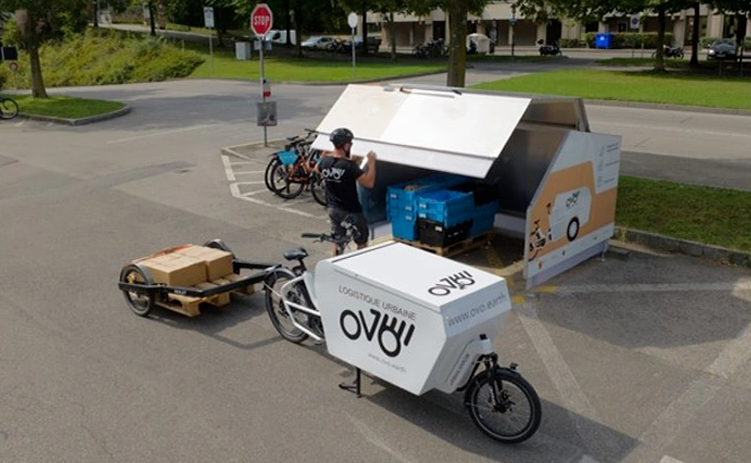
What exactly is a nano-hub and how does it work?
Opposite the macro logistics centers located miles away from urban cores, a nano-hub is a small-format, modular infrastructure distributed strategically right at street level.
Its philosophy stems from a principle of maximum efficiency: instead of vans or trucks making multiple, tedious deliveries in hard-to-access areas, they make a single centralized drop-off at an easily accessible neighborhood nano-hub. From there, fleets of cargo bikes take charge of the final distribution.
Olivier Starkenmann, cofounder of OVO Logistics, summarized it by saying that «the objective is to use the right vehicle for the right task; we call this multimodal logistics. But to optimize it, we must be able to transship goods from one vehicle to another as close as possible to the destinations».
Furthermore, for local administrations, this eliminates one of their biggest urban headaches. In the words of Cristina Paraira, Deputy Mayor for Urban Management, Mobility, and Climate Change at the City Council of Sant Cugat del Vallès: «There is no need to rent commercial spaces, which is one of the problems that often arises for us, and we can carry out last-mile distribution in a sustainable way, with less noise, less pollution, and applying circular economy criteria».
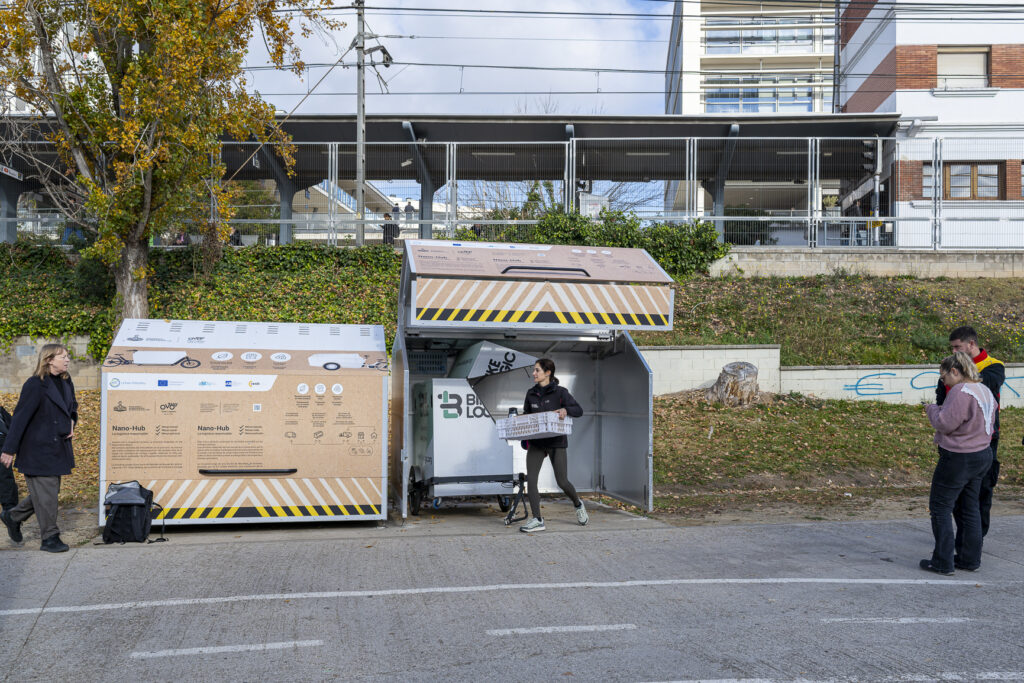
Multi-Operator and Equipped with Autonomous Technology
One of the great revolutions of this concept is that we are not looking at isolated metal boxes, but rather modular, multi-operator zones. They allow different delivery companies to share these strategic points on the roadway according to the needs of each zone, adapting to the available space without monopolizing public property.
And unlike traditional depots—which demand costly staff supervision and physical security—the technology, backed by Don Cicleto, is the true backbone of the system:
- Smart management and bookings: A centralized software optimizes the allocation of spaces among fleets.
- Autonomous app access: Delivery riders use a mobile application to open their assigned nano-hub remotely, securely, and frictionlessly throughout their workday.
«There is no need to rent commercial spaces, which is one of the problems that often arises for us, and we can carry out last-mile distribution in a sustainable way, with less noise, less pollution, and applying circular economy criteria»
Giving the Street Back to the People
A network of strategically located nano-hubs creates cities that are more efficient, livable, and—why not say it—improves public health.
Nano-hubs are no longer a lab promise; they are the silent infrastructure rewriting the way goods and cities move toward the future. Let’s move with them.